The Return to First Principles: Why Deep Reading Matters
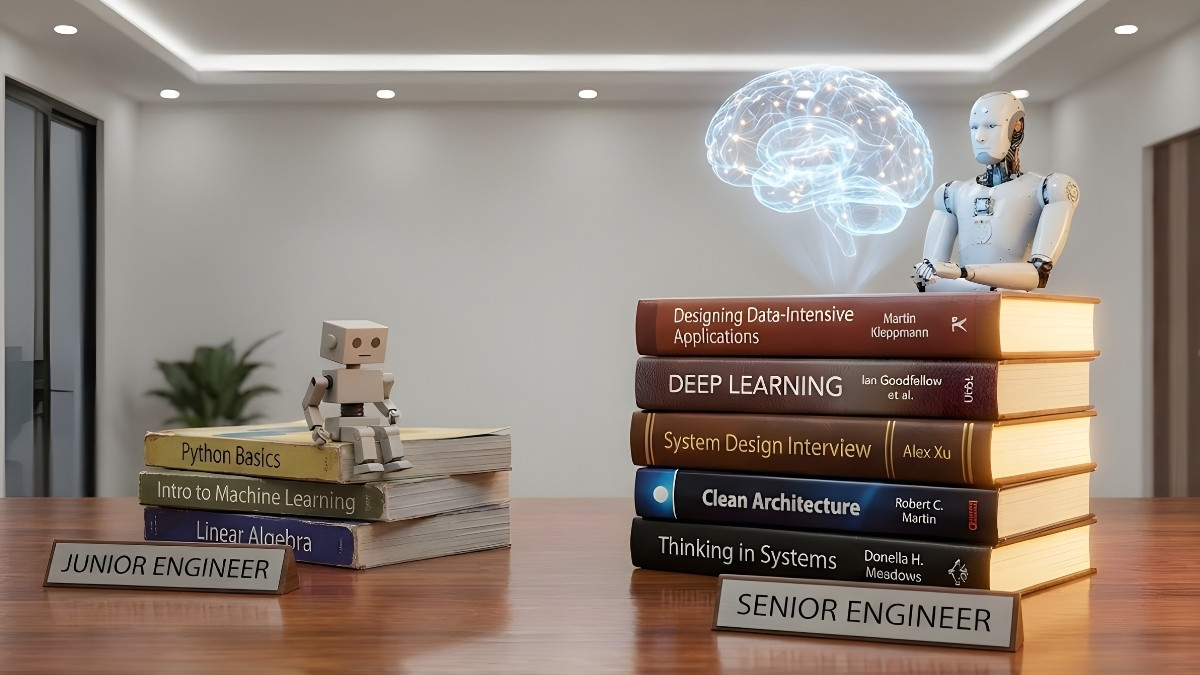
Building a resilient AI career in 2026 requires more than just skimming Stack Overflow; it demands a return to first principles. In a US tech market saturated with “bootcamp graduates” who can clone a GitHub repo but cannot explain the math behind a gradient descent, deep knowledge has become the ultimate arbitrage. While online courses are excellent for learning the syntax of the week (be it PyTorch or JAX), books remain the superior medium for internalizing the invariant truths of the field—the mathematics, the architecture, and the strategic intuition that do not change with every software update.
The engineers commanding $250,000+ salaries at companies like Anthropic and Databricks are rarely the ones who watched the most YouTube tutorials. They are the ones who have engaged in the “deep work” required to understand the underlying theory. A successful AI career is built on this bedrock of understanding, which allows you to debug a model when the library fails and to innovate when the tutorial ends.
1. The Strategist’s Playbook
For those just entering the field, the danger is getting lost in the weeds of syntax before understanding the forest. To lay the groundwork for a long-term AI career, you need context.
-
“Machine Learning Yearning” by Andrew Ng: This is not a textbook; it is a strategy guide. Ng teaches you how to structure ML projects, how to set technical direction, and when to use end-to-end deep learning versus simpler methods. It is essential for avoiding the “shiny object syndrome” that kills many junior projects.
-
“Artificial Intelligence: A Guide for Thinking Humans” by Melanie Mitchell: Before you code, you must understand the landscape. Mitchell provides the necessary skepticism and historical context, separating the hype from the reality of what current AI can actually do.
2. The Practitioner’s Bible
Once you move past the concept phase, your AI career depends on execution. The US market hires for “deployment capability,” and that requires a mastery of modern frameworks.
-
“Hands-On Machine Learning with Scikit-Learn, Keras, and TensorFlow” by Aurélien Géron: If there is a single book that will get you hired, this is it. It is the gold standard for applied machine learning. It bridges the gap between theory and code, providing the practical recipes needed to build systems that actually run.
-
“Deep Learning with Python” by François Chollet: Written by the creator of Keras, this book offers a unique, intuitive perspective on neural networks. It is less about the math and more about the “grokking”—developing a mental model of how deep learning processes information.
Also Read : Starting an AI Career: The 5 Traps That Kill Your Salary Potential
3. The Math Filter (The Gatekeeper)
This is where the herd thins out. To advance your AI career into research or senior architecture roles, you must confront the mathematics.
-
“Pattern Recognition and Machine Learning” by Christopher Bishop: This book is the filter. It is dense, mathematical, and rigorous. Mastering it signals to employers that you are not just a user of libraries, but a master of the underlying statistics. It is a staple in the interview prep for top-tier labs like Google DeepMind.
-
“Reinforcement Learning: An Introduction” by Sutton & Barto: As we move toward agentic AI, this text is becoming critical. It is the foundational text for understanding decision-making agents, a skill set that is currently seeing an explosion in demand.
4. The Ethical Component
Finally, a sustainable AI career requires an understanding of impact. As regulation tightens in the US and EU, companies are desperate for professionals who understand the risks.
-
“Weapons of Math Destruction” by Cathy O’Neil: This is the manual on what not to do. It explores how algorithms can reinforce inequality, a critical perspective for anyone building user-facing systems.
For those looking to dive deeper into the theoretical foundations without spending a dime, the Deep Learning Book by Goodfellow, Bengio, and Courville is available online and remains the definitive academic resource for the field.
The shelf life of a YouTube video is six months; the shelf life of these books is decades. In an industry defined by speed, the counter-intuitive secret to a thriving AI career is slowing down enough to understand the source code of the intelligence itself. Read the documentation, yes, but study the books to understand the machine.
Also Read : AI Career Myths vs. Reality: What Recruiters Actually Want