The Gatekeeping Engine: Fear vs. Reality
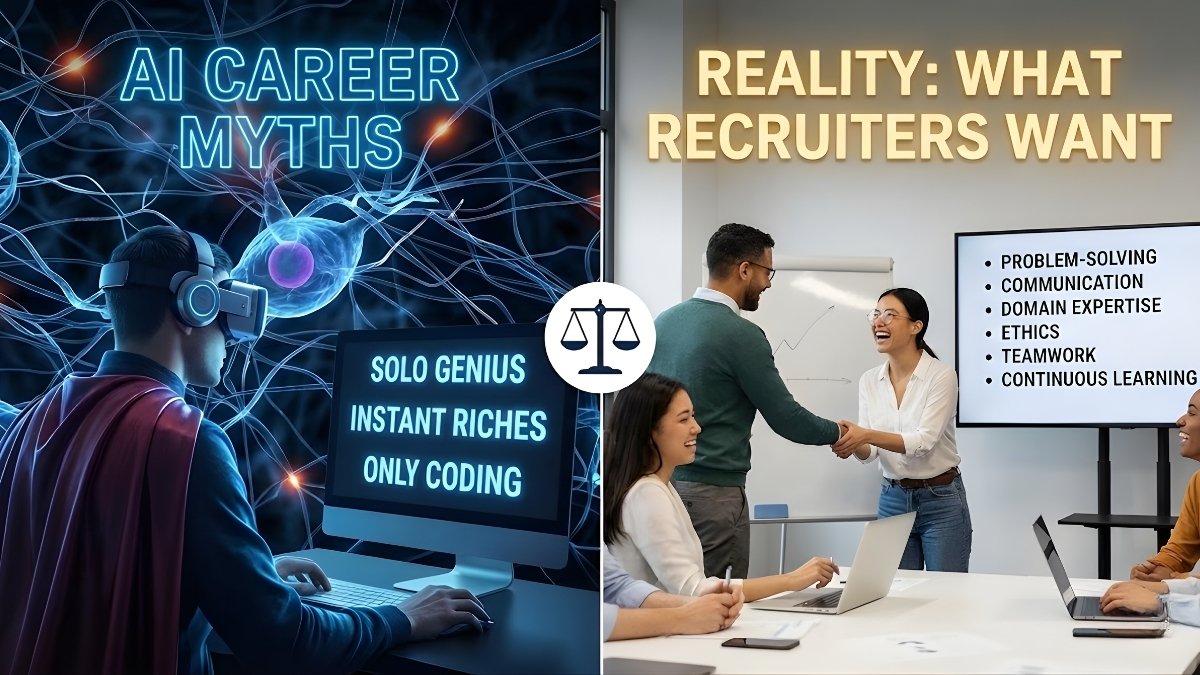
AI Career Myths are currently the single biggest bottleneck preventing the US tech workforce from modernizing effectively. For years, a narrative has been constructed around artificial intelligence that positions it as an exclusive club for the academic elite—a walled garden accessible only to those with doctorates from MIT or Stanford. This narrative is not just wrong; it is economically damaging. In 2026, the industry is starving for practical talent, yet thousands of capable engineers and product leaders self-select out of the funnel because they believe they lack the “required” pedigree.
This psychological barrier is what we call the “Imposter Industrial Complex.” It feeds on insecurity. But if you look at the hiring data from companies like NVIDIA, Capital One, or emerging startups, the reality contradicts these long-standing AI Career Myths. The market has pivoted from research to application, and the requirements for entry have fundamentally changed.
Myth 1: The “PhD or Bust” Fallacy
Perhaps the most damaging of all AI Career Myths is the idea that you need a PhD to contribute value. While this remains true for pure research roles at DeepMind, it is patently false for 95% of the industry. The vast majority of AI work today is engineering, not science. Companies need people who can fine-tune existing models, optimize inference pipelines, and build clean APIs. They need “AI Engineers,” not “AI Researchers.” A solid GitHub portfolio showing you can deploy a Llama-3 model is worth more to a Series B startup than a theoretical thesis on backpropagation.
Myth 2: The Math Genius Requirement
Another persistent barrier among AI Career Myths is the belief that you must be a linear algebra prodigy. This is a legacy mindset from 2015. Today, modern frameworks like PyTorch and TensorFlow have abstracted away the complex calculus. You need intuition, not derivation. You need to understand what a loss function does, not necessarily how to derive it by hand on a whiteboard. The focus has shifted to “Applied Math”—understanding metrics, statistical significance, and data distribution.
Myth 3: “It’s Only for Coders”
The ecosystem has expanded significantly. One of the newer AI Career Myths is that if you can’t write Python, you can’t work in AI. This ignores the massive explosion of the “AI Product Manager” and “AI Ethics” roles. As models become products, the need for humans who can define strategy, manage risk, and design user experiences is skyrocketing. The Generative AI for Everyone course by Andrew Ng highlights how domain experts in law, medicine, and finance are now building specialized agents without writing a single line of code.
Also Read : The Resume Glut: Why 90% of AI Candidates Are Being Rejected
Myth 4: The “Big Tech” Monopoly
Many candidates believe that if they don’t work at a FAANG company, they aren’t really working in AI. This is one of those AI Career Myths that limits your earning potential. The most interesting (and stable) work is often happening in legacy sectors undergoing transformation. JPMorgan Chase spends more on technology than many tech companies. Healthcare networks, logistics giants like FedEx, and defense contractors are aggressively hiring. These sectors often offer better work-life balance and comparable salaries to big tech, with less volatility.
Myth 5: The Saturation Scare
“Is it too late?” This question drives many AI Career Myths that suggest the gold rush is over. The data suggests we are barely at the end of the beginning. We have moved from the “Training Phase” to the “Deployment Phase.” The demand for MLOps, security, and integration specialists is just starting to ramp up. The market is competitive, yes, but it is competitive for quality, not just quantity.
The industry thrives on mystique, but you shouldn’t buy into it. These AI Career Myths serve only to keep supply low and salaries high for the incumbents. The barrier to entry has never been lower regarding tools and access to knowledge. The only remaining barrier is the one in your head. The market rewards those who build, ship, and solve problems—regardless of what the rumors say. Ignore the noise and start building.
Also Read : Proving AI Skills: Why GitHub Is Worth More Than a Harvard Degree