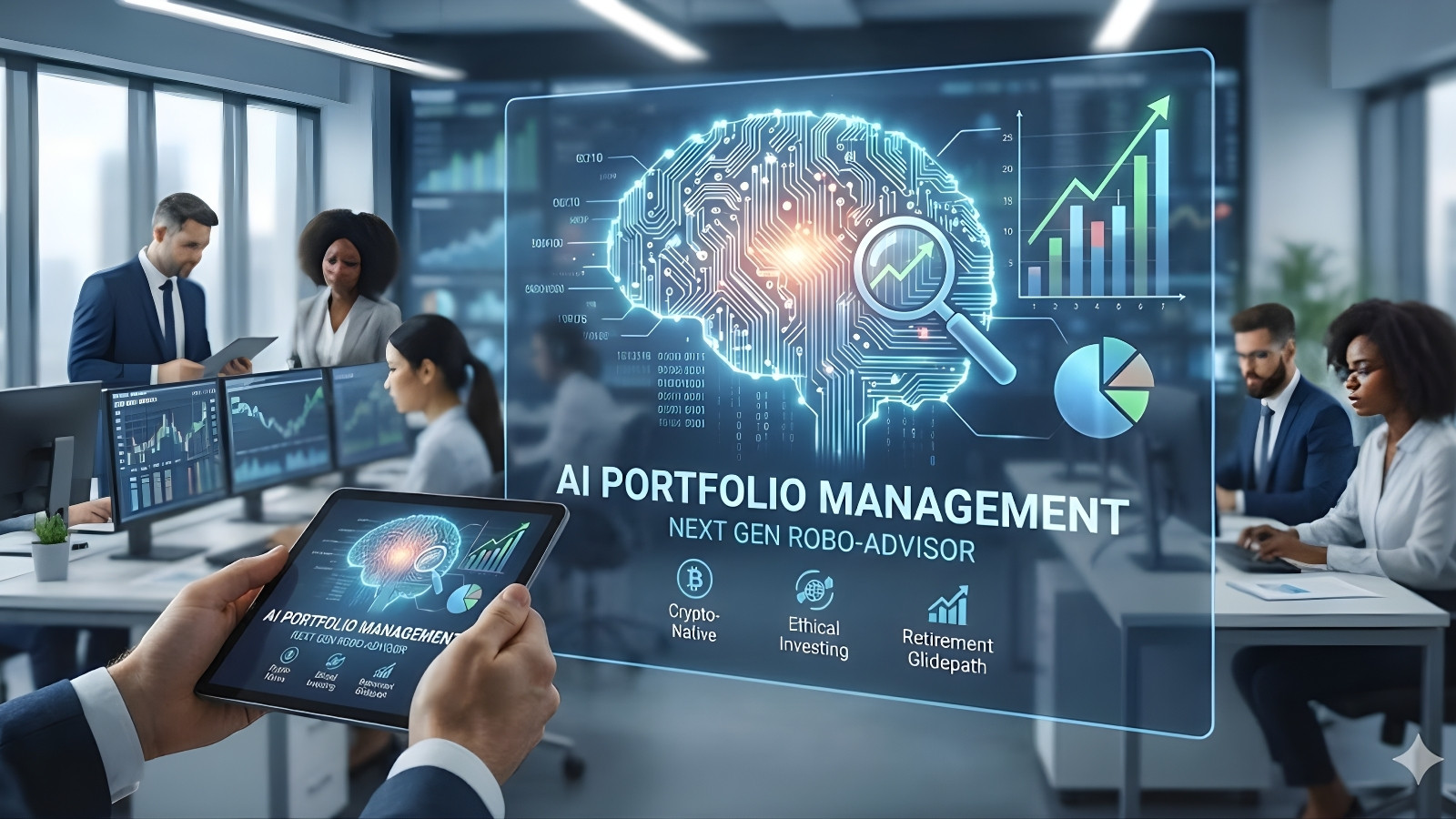
AI Portfolio Management: Building the Next Gen Robo-Advisor
The financial markets are no longer driven by humans shouting on a trading floor. They are driven by algorithms, high-frequency data, and millisecond decisions. In this hyper-speed environment, the average retail investor—and even many professional advisors—are at a massive disadvantage. They are bringing a knife to a gunfight. This disparity has created a massive opening for AI Portfolio Management solutions.
For fintech founders, developers, and data scientists, this is the frontier. We are moving beyond simple “budgeting apps” into the realm of autonomous wealth creation. By building a platform that leverages AI Portfolio Management, you are not just offering a dashboard; you are offering a personalized hedge fund manager that fits in a user’s pocket. You are democratizing the kind of sophisticated asset allocation that was once reserved for billionaires.
The Psychology of Wealth
Why do investors consistently underperform the market? It isn’t a lack of intelligence; it is an abundance of emotion. Fear makes us sell at the bottom. Greed makes us buy at the top. This “behavioral gap” costs investors billions every year.
This is where your tool shines. An AI Portfolio Management system is cold, calculating, and rational. It doesn’t care about a scary news headline or a hype-filled tweet. It cares about data. When you market this tool, you are selling “discipline as a service.” You are promising the user that their money will be managed by logic, not by their own anxiety. This promise of emotional detachment is a powerful selling point that drives user adoption.
Niche Down: Be Specific to Be Profitable
The “robo-advisor” market has giants like Betterment and Wealthfront. To compete, you shouldn’t try to be everything to everyone. You need to carve out a specialized niche for your AI Portfolio Management services.
1. The “Crypto-Native” Rebalancer Crypto portfolios are incredibly volatile. A standard 60/40 stock/bond split doesn’t work here. Build a tool that dynamically rebalances a user’s crypto holdings based on on-chain data and volatility indexes. If Bitcoin drops 10%, the AI automatically moves funds into stablecoins to preserve capital.
2. The “Ethical Investing” Optimizer Millions of young investors want to support green companies but don’t know how to screen stocks. Create an AI engine that scans thousands of companies for ESG (Environmental, Social, and Governance) scores and builds a custom portfolio that aligns with the user’s specific values (e.g., “No fossil fuels” or “High gender diversity”).
3. The “Retirement Glidepath” for Freelancers Freelancers don’t have 401(k)s. They have uneven income streams. Build an AI Portfolio Management tool that adjusts its risk tolerance based on the user’s monthly cash flow. If they have a good month, it invests aggressively. If they have a lean month, it shifts to conservation mode.
Also Read : From Compliance to Cash Flow : Mastering AI Risk Management
The Business Model: Assets Under Management vs. SaaS
How do you make money? In fintech, trust is the currency, and your pricing model needs to reflect that.
-
The SaaS Subscription: This is the cleanest model for software developers. Charge a flat monthly fee (e.g., $19/month) for access to the platform’s insights and automated rebalancing features. It is predictable and scalable.
-
The AUM Fee: This is the traditional advisor model. You charge a small percentage (e.g., 0.25%) of the total assets managed by your AI Portfolio Management software. As your users get richer, you make more money.
-
The “Freemium” Insight: Offer the portfolio tracking and basic risk analysis for free. If the user wants the AI to actually execute the trades or perform “Tax-Loss Harvesting,” they upgrade to the premium tier.
Building the Tech Stack
This is a high-stakes engineering challenge. You are handling people’s life savings, so security and accuracy are paramount.
-
The Data: You need real-time feeds. APIs like Alpaca or IEX Cloud provide market data. For connecting to user bank accounts, Plaid or Yodlee are the industry standards.
-
The Brain: Python is the language of finance. Use libraries like
pandasfor data manipulation andPyPortfolioOptfor efficient frontier optimization. For the predictive element, models like XGBoost or LSTMs (Long Short-Term Memory networks) can analyze historical trends to forecast future risk. -
The Execution: You don’t need to build a brokerage. Use “Brokerage as a Service” APIs like Alpaca or DriveWealth. They handle the regulatory heavy lifting of buying and selling stocks, while your code provides the logic.
Marketing Your Algo
In finance, you cannot just hype a product; you have to prove it works.
-
Backtesting is King: Don’t just say your AI is smart. Show the data. Publish reports showing how your AI Portfolio Management strategy would have performed during the 2008 crash or the 2020 pandemic compared to the S&P 500. Visual charts showing “Capital Preservation” are incredibly persuasive.
-
Trust Signals: Security badges, encryption standards, and partnerships with known custodians (like Apex Clearing) should be plastered on your homepage. You are asking for trust; give them reasons to trust you.
-
Educational Content: Write deep-dive articles on “Modern Portfolio Theory” or “The Math of Diversification.” Position your brand as a sophisticated financial authority, not just a tech app.
The Future of Wealth
We are moving toward a world of “Self-Driving Money.” In the near future, AI Portfolio Management won’t just be about stocks. It will optimize a user’s entire financial life—moving money between savings, paying off debt, and investing in real estate automatically. By building the core engine today, you are laying the rails for the autonomous financial future. You are giving the average person the power of a Wall Street institution.
Also Read : Real Estate Markets : Why AI Is the New Real Estate Agent