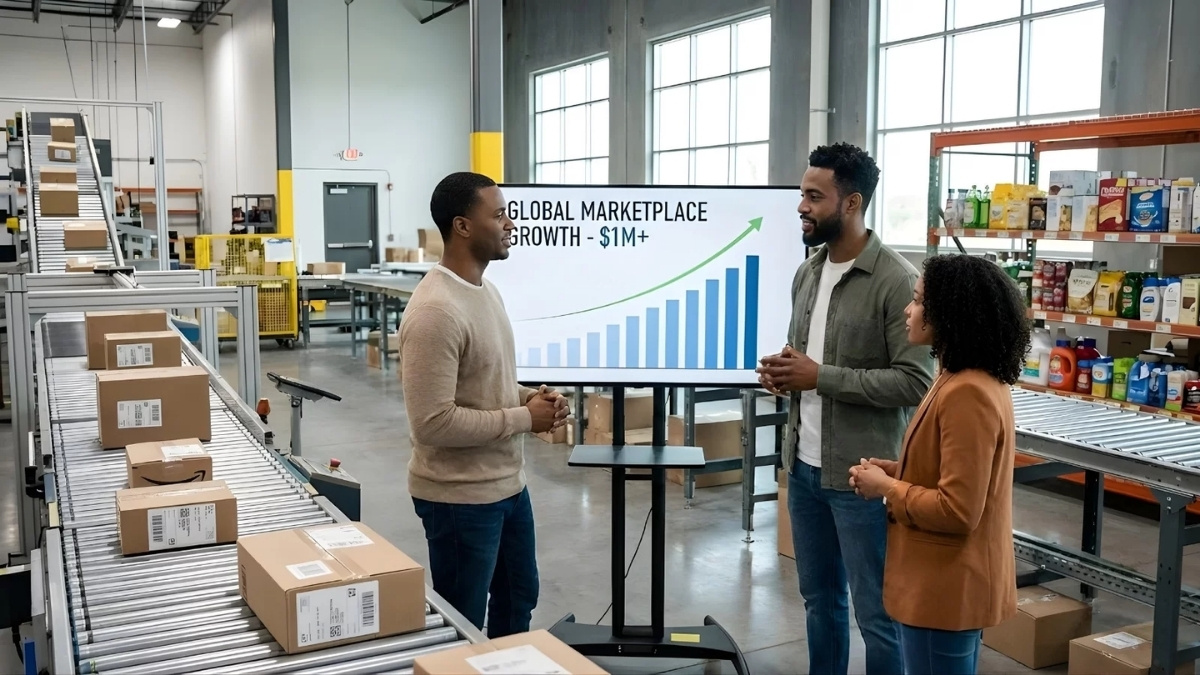
Why a Goods Marketplace Beats Every Other eCommerce Model in 2026
Goods marketplace businesses are quietly minting millionaires in 2026 — and the founders getting there fastest are the ones who stopped trying to build everything themselves.
Worldwide online retail sales are projected to approach $7.5 to $8 trillion by 2026, up from $6.3 trillion in 2024. OpenPR McKinsey estimates agentic commerce will represent $1 trillion in US revenue — approximately 12% of total retail sales. That is not incremental growth. It is a fundamental redistribution of commerce. Appverticals The retailers and marketplace builders capturing that redistribution are not the ones with the biggest warehouses. They are the ones with the best data, the cleanest product feeds, and the AI infrastructure that makes their inventory discoverable when AI shopping agents go looking.
This business model in 2026 does not require inventory. It does not require a warehouse. In many cases, it does not require a team. What it requires is a clear niche, a platform that connects buyers and sellers efficiently, and the AI tools that automate the operations that would otherwise demand constant human attention.
The Structural Economics That Make This Business Model Unbeatable
The fundamental economics of a goods marketplace are structurally superior to traditional eCommerce in 2026 — and the gap is widening.
A traditional eCommerce business carries inventory risk, shipping costs, and customer service overhead on every transaction. A goods marketplace carries none of those risks. Every transaction happens between a buyer and a third-party seller. The marketplace operator takes a commission — typically 5% to 20% depending on category — on every transaction that clears the platform without touching the product, managing the return, or absorbing inventory loss.
This is why Amazon, Etsy, and eBay generate billions in gross merchandise volume without owning the products that generate it. And in 2026, the infrastructure that used to require $50 million in engineering investment to build is now accessible to a solo founder for under $500 per month.
Also Read : How AI Pitch Decks Are Helping Founders Raise Millions Faster in 2026
The AI Tools That Make a Goods Marketplace Operable Without a Team
The businesses generating million-dollar revenue in 2026 are not running lean teams. They are running AI-powered operations where the tools handle the volume that previously required people.
AI-Powered Product Data Management
The single most critical technical challenge in any goods marketplace is product data quality. AI agents can only recommend products they know about. Expanded assortment dramatically increases discoverability — every seller becomes a content contributor enriching the dataset agents access. More products mean more relevance signals. More reviews mean more context. CompaniesHistory
Tools like Mirakl Catalog Platform enforce data standards with automated audits, ensuring product feeds remain clean and structured without manual review on every SKU. For a niche platform, the equivalent is setting data standards that sellers must meet — and using AI classification tools to catch inconsistencies before they reach the storefront.
AI Shopping and Discovery
The goods marketplace advantage in 2026 is directly connected to AI commerce. Perplexity launched a shopping experience with conversational product discovery and instant checkout powered by PayPal. OpenAI embedded checkout directly into ChatGPT. If 2025 was the year that companies laid the groundwork for agentic commerce, 2026 is the year retailers and tech giants put their strategies to the test. Zylo
Every one of these AI shopping channels is a distribution opportunity for a goods marketplace with clean, structured product data and real-time inventory accuracy. The marketplace that feeds agents accurate, rich product data gets recommended. The platform with stale catalogs and missing attributes does not.
Automated Customer Service
AI chatbots handle 80% of customer service inquiries for operators who deploy them correctly. Inquiry routing, order status updates, return initiation, and FAQ resolution run entirely without human intervention in the best-configured marketplaces. The remaining 20% that requires human judgment — disputes, unusual return scenarios, seller escalations — is where operator time actually belongs.
Also Read : Coloring Books: 5 Proven AI Niches Making $10K Monthly Passive Income
The 5 Niche Goods Marketplace Categories Generating Million-Dollar Revenue in 2026
Niche selection is where most marketplace businesses succeed or fail before they launch their first product.
Specialty and Artisan Goods
Etsy processes billions in gross merchandise sales annually — but its scale creates the opportunity for focused competitors. A platform specializing in one specific category of artisan products — handmade woodworking, ceramic homeware, independent textile designers — can provide curation, seller community, and buyer trust that Etsy’s general model cannot replicate in depth. Specialty buyers pay premium prices and have higher LTV than general merchandise buyers. Sellers pay higher commissions to access a curated buyer base that values their work. The platform earns on both sides.
Recommerce and Resale
By 2026, resale and recommerce programs are becoming mainstream, with IKEA’s buy-back program expanding globally and luxury brands partnering with resale platforms. OpenPR The resale model has a structural advantage that new goods platforms do not: inventory replenishes itself through seller supply. Categories with the strongest resale economics include luxury fashion, high-end electronics, specialty sporting equipment, and collectibles.
B2B Goods Marketplace
The B2B goods marketplace opportunity is larger and less competitive than B2C equivalents. 1 in 5 B2B sellers will be compelled to respond to AI-powered buyer agents with dynamically delivered counteroffers via seller-controlled agents. Hostinger B2B buyers have higher average order values, longer customer relationships, and more predictable buying cycles than B2C buyers. Specialty industrial supplies, professional equipment, and wholesale goods for independent retailers are all categories where a focused B2B goods marketplace provides genuine value.
Local and Regional Goods
The local marketplace model fills a gap that global platforms structurally cannot fill — connecting buyers who specifically want local products with sellers who specifically want to reach local buyers. Farmers market goods for pre-order and delivery. Independent bookstores with local author inventory. Local artisan goods discoverable online but purchasable locally. This category combines eCommerce infrastructure with community dynamics that national platforms cannot replicate.
Digital Goods Marketplace
Digital products — templates, design assets, code libraries, AI prompts, educational resources — have the most favorable economics of any marketplace category. Zero shipping cost. Zero inventory. Instant delivery. Alex discovered a gap in the market for high-quality, culturally diverse stock photos, created them using Midjourney, and uploads to Adobe Stock and Shutterstock — generating $3,000 to $8,000 monthly from 2,000 to 3,000 licenses at $0.33 to $3.00 each. BetterCloud A digital goods marketplace captures a percentage of every transaction with no physical logistics layer.
Also Read : AI Ethics: 7 Legal Risks Quietly Destroying Businesses in 2026
How to Monetize a Goods Marketplace — The Revenue Structures That Scale
A goods marketplace generates revenue through multiple complementary streams. The platforms generating million-dollar revenue in 2026 are running three to five revenue streams simultaneously.
Transaction Commission
The baseline revenue structure. 5% to 15% on every transaction in most categories, rising to 20% to 30% for digital goods and curated luxury categories. Commission revenue scales directly with gross merchandise volume and requires no incremental cost at the transaction level.
Seller Subscription and Listing Fees
Charging sellers a monthly subscription for marketplace access — $20 to $200 per month depending on tier — creates predictable recurring revenue independent of transaction volume. Listing fees for featured placement generate additional revenue while providing sellers with measurable promotional value.
Promoted Listings and Advertising
Once the goods marketplace reaches sufficient buyer traffic, promoted listings — where sellers pay for higher visibility in search results — become one of the highest-margin revenue streams available. Amazon generates tens of billions in advertising revenue annually from this model. A niche goods marketplace with 50,000 monthly buyers can generate meaningful advertising revenue from sellers competing for visibility in a category where buyer intent is already confirmed.
Buyer Membership Programs
A buyer subscription — $5 to $15 per month — that provides free shipping, early access to new sellers, and exclusive offers converts frequent buyers into a recurring revenue stream that stabilizes platform economics against transaction volume volatility.
Data and Insights Services
The data generated by a goods marketplace — what buyers search, view, purchase, and return — is valuable to sellers who want to understand demand before producing inventory. Monetizing that data as a subscription analytics service creates a high-margin revenue stream that requires no additional operational overhead beyond what the platform already generates.
Building to a million dollars in revenue requires three years of deliberate catalog expansion, seller acquisition, and buyer growth in most cases. The operators who get there pick a niche narrow enough to dominate before expanding, build the AI operational layer before it becomes painful to operate without, and focus relentlessly on the data quality that determines whether AI shopping agents discover their platform or ignore it.
Frequently Asked Questions
1. How much does it cost to build a goods marketplace in 2026?
A functional platform can launch for $500 to $2,000 per month using platforms like Sharetribe or Marketplacer — plus Stripe for payments and AI tools for customer service and catalog management. Custom-built marketplaces require $50,000 to $200,000 in development investment before launch.
2. What commission rate should a goods marketplace charge sellers in 2026?
Standard rates run 5% to 15% for physical goods, 15% to 25% for digital goods, and 20% to 30% for curated luxury categories. Most successful marketplaces combine commission and seller subscription models for revenue stability.
3. How long does it take to reach $1 million in goods marketplace revenue?
Most businesses in this model reach $1 million in gross merchandise volume within two to three years of focused niche execution. Reaching $1 million in platform revenue from commissions, subscriptions, and advertising typically requires $5 to $10 million in gross merchandise volume.
Which goods marketplace niche are you considering building in 2026? Drop it in the comments.