The Code to Success: Choosing the Right Language for AI Careers
If you are aiming to build a strong future in the world of technology, selecting the right programming language is one of the very first steps you need to take. We are seeing a massive shift right now. With Artificial Intelligence transforming major US industries—from cutting-edge healthcare in Boston to high-stakes finance in New York—the demand for skilled professionals is skyrocketing.
But here is the thing: not all coding languages are created equal. Choosing the right one can help you understand complex concepts more deeply and, more importantly, open doors to high-paying roles like Machine Learning Engineer or Data Scientist. If you are looking to launch one of the many successful AI careers available today, you need a toolkit that matches the market demand.
Here is a deep dive into the top programming languages that are shaping the US tech landscape, why they matter, and where each one shines.
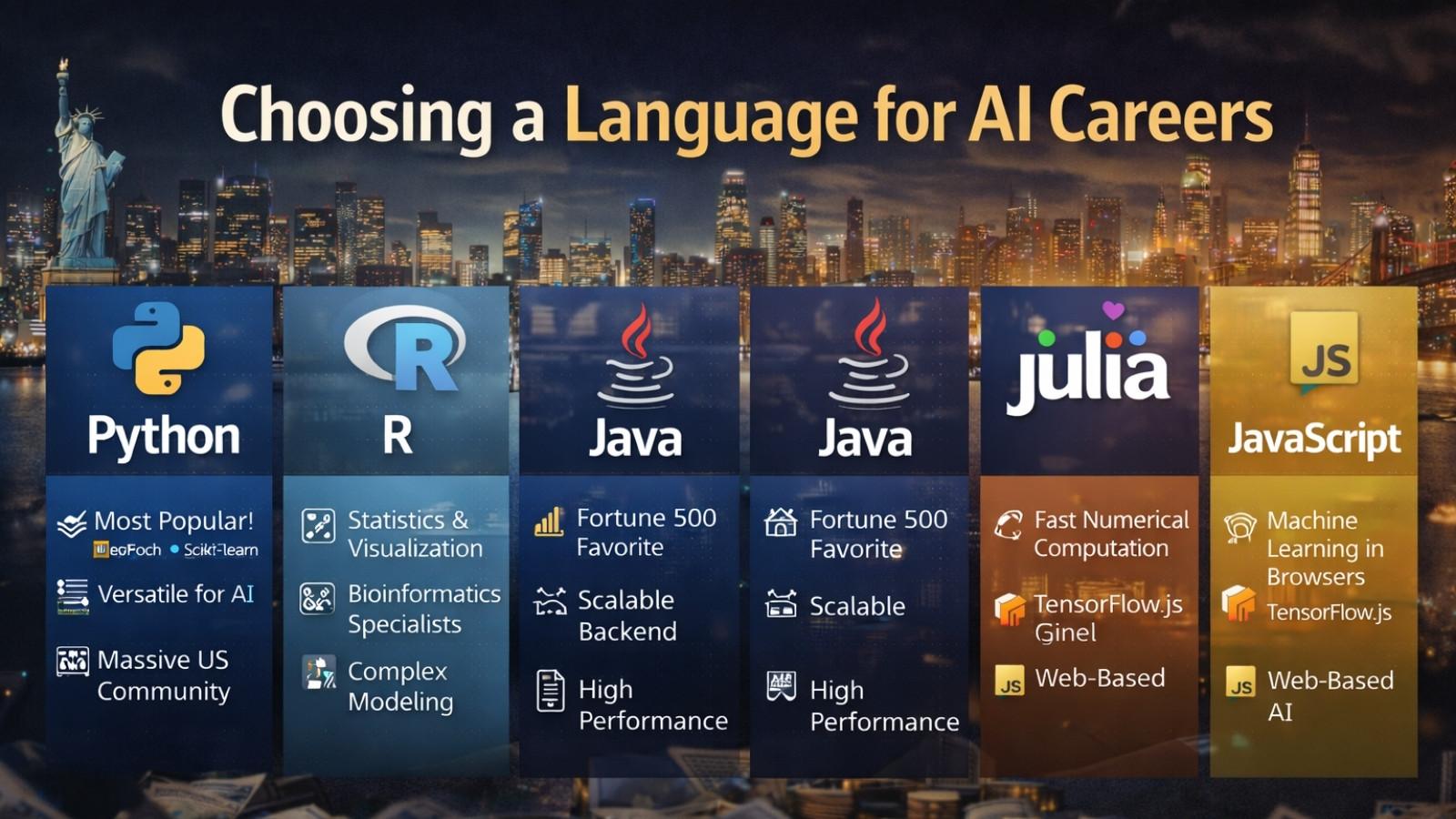
1. Python – The Undisputed King
Let’s be honest: if you are entering this field, Python is your best friend. It is by far the most widely used language in development today. Its clean syntax reads almost like English, which is why it is the top choice for professionals starting their AI careers in Silicon Valley and beyond.
Why it matters:
-
Libraries: It powers the heavy hitters like TensorFlow, PyTorch, and Scikit-learn.
-
Versatility: It is excellent for everything from Natural Language Processing (NLP) to predictive analytics.
-
Community: The support network in the US is massive. If you get stuck, there is a forum post from yesterday with the answer.
2. R – The Statistician’s Favorite
While Python is a generalist, R is a specialist. It was designed for statisticians and data miners. If your dream job involves handling massive datasets for a pharmaceutical company or a hedge fund, R is often the go-to tool for these data-driven AI careers.
Why it matters:
-
Visualization: Packages like ggplot2 allow you to create stunning data visualizations that stakeholders love.
-
Modeling: It has built-in support for complex linear and non-linear modeling.
-
Niche: It dominates in bioinformatics and computational biology sectors.
Also Read : AI Jobs Salary: The Truth About Tech Pay in the US
3. Java – The Corporate Backbone
You might think of Java as “old school,” but in the US corporate world, it is still a powerhouse. Java is incredibly scalable, which is why large enterprises use it for their backend systems. As these companies integrate intelligence into their existing stacks, Java becomes a practical choice for stable AI careers in the Fortune 500.
Why it matters:
-
Scale: It is perfect for large-scale, fraud detection systems used by banks like Wells Fargo or Chase.
-
Performance: The JVM (Java Virtual Machine) ensures speed and cross-platform compatibility.
-
Tools: Libraries like Deeplearning4j make it easier to implement deep learning without leaving the Java ecosystem.
4. Julia – The Speed Demon
Julia is the new kid on the block, but it is turning heads. Designed specifically for high-performance numerical computing, it is becoming a secret weapon for AI careers that involve heavy mathematical lifting.
Why it matters:
-
Speed: It offers execution speeds comparable to C, making it lightning-fast.
-
Math: It has native support for parallel and distributed computing, ideal for scientific research and simulations.
5. C++ – Performance First
For systems where every microsecond counts—like high-frequency trading platforms in Chicago or gaming engines in Los Angeles—C++ is king. It is harder to learn than Python, but mastering it can lead to very lucrative AI careers in robotics and autonomous systems.
Why it matters:
-
Control: It allows for direct memory management, which is crucial for hardware-constrained environments like self-driving cars.
-
Efficiency: It powers the core engines of many machine learning libraries.
6. JavaScript – AI in the Browser
Yes, you read that right. JavaScript is no longer just for making websites pretty. With the rise of TensorFlow.js, it is becoming a viable option for web-based applications.
Why it matters:
-
Accessibility: It allows you to run machine learning models directly in the user’s browser, ensuring privacy and speed.
-
Interactivity: Great for creating interactive educational tools or real-time creative apps.
How to Choose?
So, which one should you pick to kickstart your journey?
-
Beginner? Start with Python. It is the safest bet for most AI careers in the US.
-
Data Nerd? If you love statistics, give R a try.
-
Enterprise? If you want to work at a big bank, Java is solid.
-
Hardware/Gaming? C++ is your path.
Whichever language you choose, remember that the language is just a tool. The real skill lies in how you use it to solve problems. Focus on building real-world projects, contributing to open source, and constantly learning. That is the true secret to building lasting AI careers in this exciting industry.
Also Read : AI Career Dilemma : Research or Industry? Choose Wisely