The Gatekeeper of Intelligence: Why Syntax Is Not Enough
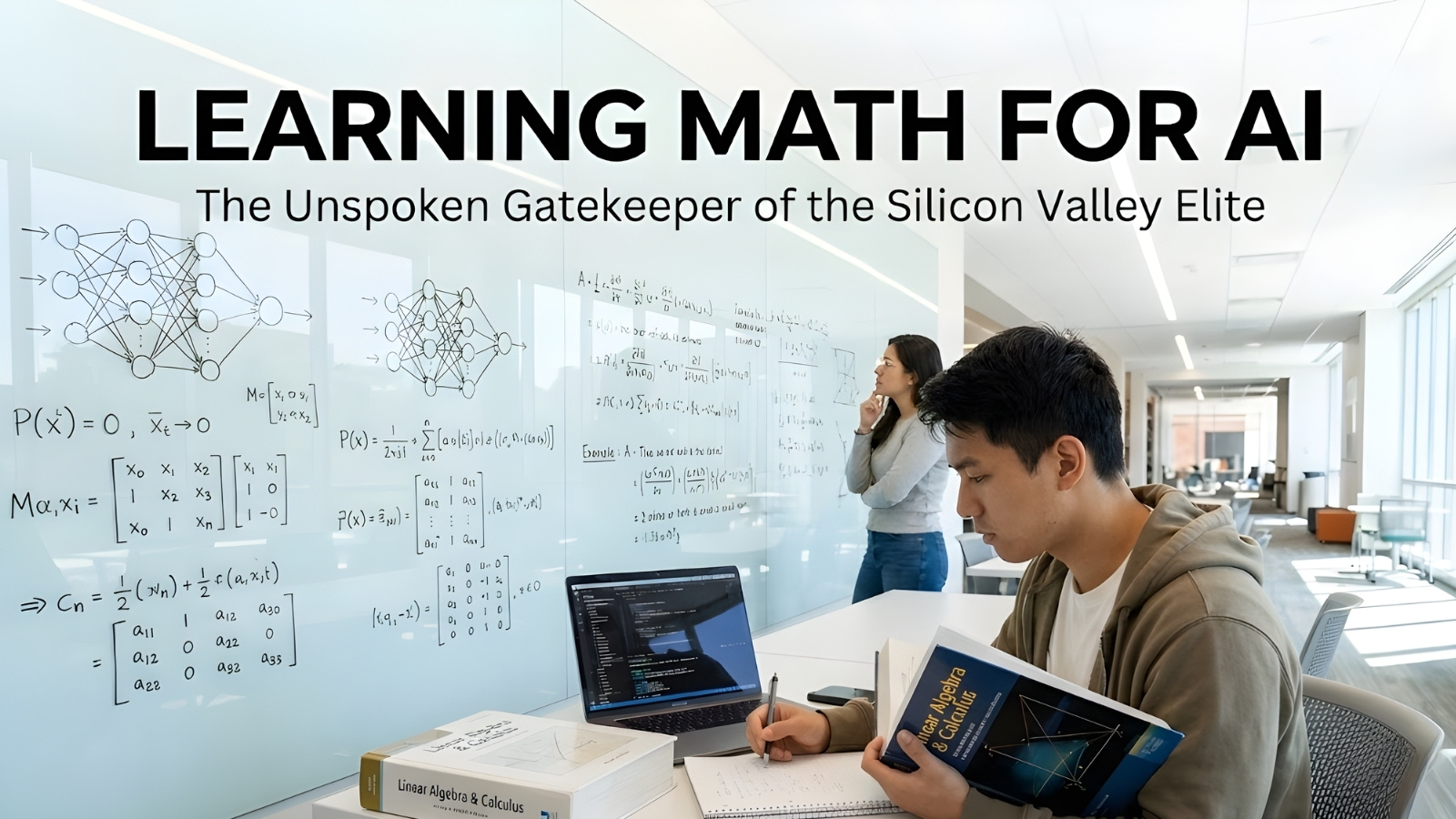
Learning Math for AI is the unspoken gatekeeper of the Silicon Valley elite, distinguishing the engineers who merely consume libraries from the architects who build them. For the last few years, the “democratization of AI” narrative convinced a generation of developers that importing TensorFlow was enough to build a career. That bubble has burst. As we move from the hype cycle into the deployment phase, companies are realizing that you cannot debug a hallucinating model or optimize a sluggish pipeline if you treat the underlying mathematics as a black box.
The reality of the market in 2026 is harsh but fair: code is cheap, but understanding is expensive. While you don’t need to be a Nobel laureate to train a model, the process of Learning Math for AI is essential for anyone who wants to move beyond the entry-level “prompt engineer” tier. It gives you the diagnostic tools to look at a loss curve and understand why it isn’t converging, rather than blindly tweaking hyperparameters until something sticks.
The Toolkit: What You Actually Need
Let’s strip away the academic fluff. You aren’t trying to pass a PhD qualifying exam; you are trying to ship product. The curriculum for Learning Math for AI boils down to three non-negotiable pillars.
1. Linear Algebra: The Engine Room This is not optional. Neural networks are essentially massive matrix multiplication machines. Understanding vectors, eigenvalues, and dot products is critical because they define how data moves through a system. If you don’t understand dimensionality, you will struggle to architecture even basic networks.
2. Calculus: The Optimizer You don’t need to solve integrals by hand on a whiteboard, but you must understand the gradient. Calculus is the study of change, and in AI, we are constantly trying to change the model’s error rate to zero. Concepts like the chain rule are the bedrock of backpropagation—the mechanism by which models actually learn.
3. Probability & Statistics: The Truth Serum AI is not magic; it is probabilistic inference. Understanding Bayes’ Theorem and normal distributions allows you to quantify uncertainty. This is especially critical in high-stakes fields like finance or healthcare, where a “guess” isn’t good enough.
If you are looking for a place to start this journey without paying tuition, Khan Academy remains one of the most effective, no-nonsense resources for mastering these foundational concepts visually.
Also Read : Women in AI: The Untapped Trillion-Dollar Opportunity
The Depth Dilemma: How Deep is Too Deep?
A common paralysis point for beginners is the depth of study. Do you need to prove theorems? No. The strategy for Learning Math for AI should be “Just-In-Time” education. You need enough theoretical depth to implement the code, but not so much that you get stuck in 19th-century proofs.
-
The Researcher: Needs advanced optimization theory.
-
The Engineer: Needs to understand matrix operations to write efficient PyTorch code.
-
The Product Manager: Needs statistical literacy to interpret A/B test results.
The Efficiency Hack
The most successful engineers don’t learn math in a vacuum; they learn it through code. The most efficient way to approach Learning Math for AI is to pair every concept with a Python script. Don’t just read about a derivative; write a script that calculates it. This “applied understanding” cements the concept faster than any textbook ever could.
The industry is maturing. The days of “fake it ‘til you make it” are ending. Recruiters are increasingly technical, and they can smell a candidate who doesn’t understand the fundamentals. Learning Math for AI is not just about passing an interview; it is about future-proofing your career against automation. The tools will change, the frameworks will evolve, but the math remains the universal constant. Master it, and you become indispensable.
Also Read : Soft Skills: The Hidden Multiplier for Your AI Salary