The Academic Bubble: Why Production Beats Publication
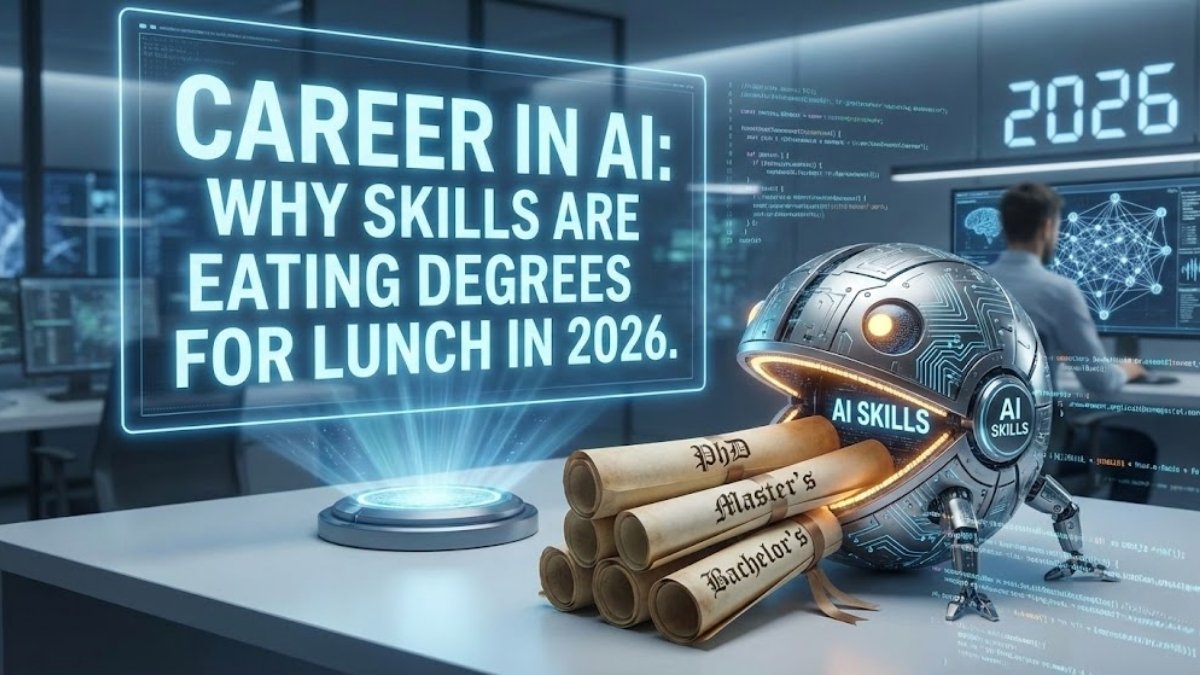
Pursuing a lucrative Career in AI was once the exclusive domain of PhD researchers, but the rapid industrialization of the field has shattered that monopoly. In 2026, the question “Do I need a PhD?” is not just a career query; it is a financial calculation. For years, the narrative in Silicon Valley was that true innovation only happened in ivory towers. However, as companies shift from “research” to “deployment,” the value of a five-year doctoral program is being aggressively questioned. The market has realized that a thesis on theoretical optimization doesn’t necessarily translate to shipping scalable code.
The reality of a modern Career in AI is that the industry is bifurcating. There is a small, elite tier of “Research Scientists” at labs like DeepMind who invent new architectures, and then there is the massive, booming army of “AI Engineers” who apply those architectures to solve business problems. The latter group—which commands salaries often rivaling the researchers—requires engineering grit, not academic tenure.
1. The Role Matrix: Where the PhD Matters (And Where It Doesn’t)
To navigate your Career in AI effectively, you must understand the distinction between “Scientific Discovery” and “Product Engineering.”
-
The Scientist (PhD Required): If your goal is to publish in NeurIPS or invent the next Transformer architecture, the doctorate is your ticket. These roles are rare, hyper-competitive, and academic in nature.
-
The Engineer (No PhD Required): This is where the volume is. A Machine Learning Engineer at Uber or a Data Scientist at Netflix does not need to derive backpropagation from scratch; they need to know how to optimize inference latency and manage data pipelines.
2. The Opportunity Cost of Academia
A critical factor often overlooked when planning a Career in AI is the opportunity cost. A PhD takes 4-6 years. In that time, an engineer in the industry could have worked on three major product launches, earned $1 million in aggregate salary, and vested significant equity.
-
The Trade-off: While the PhD might raise your “ceiling” for specific research roles, it lowers your “floor” by removing you from the workforce during your prime earning years. In a field that moves as fast as AI, graduating with knowledge from 2021 in 2026 is a recipe for obsolescence.
Also Read : Research Papers in AI: The Arbitrage Between Academia and a $500k Salary
3. The Rise of “Applied AI”
The most exciting segment of a Career in AI today is not in inventing new models, but in applying them. The “Application Layer” is exploding.
-
The Skill Set: Companies are desperate for professionals who can take a pre-trained model (like GPT-5 or Llama-3) and fine-tune it on proprietary data. This requires skills in MLOps, data cleaning, and system architecture—skills that are rarely taught in a PhD program but are learned quickly in a startup environment.
4. The Portfolio Over Pedigree
In 2026, a GitHub profile with a deployed application is worth more than a CV with a list of citations. When building your Career in AI, focus on “Proof of Work.”
-
The signal: A candidate who has built an open-source agent that automates legal research has demonstrated more value than a candidate who wrote a paper on a theoretical loss function that was never implemented.
5. Alternatives to the Ivory Tower
If you decide to skip the PhD, you are not closing the door on a high-level Career in AI; you are simply choosing a different entrance.
-
Micro-Credentials: Specialized courses from DeepLearning.AI often provide more relevant, up-to-date knowledge than university curricula.
-
Kaggle Grandmaster: Achieving a high rank in global competitions signals elite problem-solving ability that recruiters respect universally.
The gatekeepers are gone. A successful Career in AI is no longer defined by the letters after your name, but by the code you ship. Unless you are committed to pure research, the smart money is on joining the workforce, building real systems, and letting the market—not a thesis committee—judge your worth.
Also Read : Hackathons Are the New Interview: Why Your Degree Doesn’t Matter