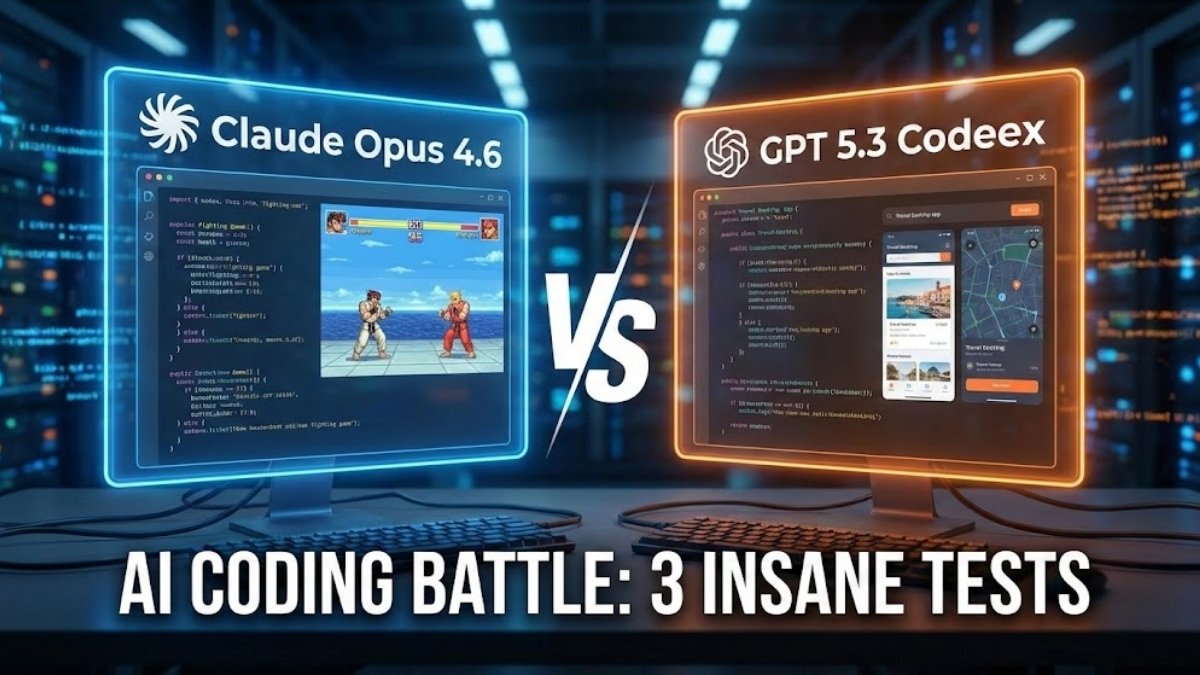
The Coding Wars Just Got Heated: OpenAI and Anthropic Drop New Models
The artificial intelligence landscape shifted dramatically in the last 48 hours. In a move that highlights just how fiercely competitive Silicon Valley has become, Anthropic released their latest model, and mere minutes later, OpenAI responded with their own update. We are looking at the simultaneous arrival of GPT 5.3 Codeex vs Claude Opus 4.6, a dual release that has developers scrambling to update their IDEs.
Instead of boring you with a spreadsheet of dry benchmarks, I decided to put these tools through the wringer. Benchmarks are fine for research papers, but they don’t tell you how a model handles a missing semicolon or a complex game logic loop. I ran identical prompts through both systems to build a fighting game, a travel app, and a portfolio site. The results were surprising, and the winner isn’t as clear-cut as you might think.
The Spec Sheet: Speed vs. Context
Before we dive into the code, let’s look at the hardware, so to speak. Claude Opus 4.6 is leaning heavily into the enterprise market. The standout feature here is the massive 1 million token context window. This is a game-changer for anyone managing legacy codebases that resemble a bowl of spaghetti. Anthropic has also introduced “Agent Teams,” allowing multiple instances of Claude to coordinate on tasks, which sounds like a dream for project management.
On the other side of the ring in this GPT 5.3 Codeex vs Claude Opus 4.6 battle, OpenAI is banking on speed. The new Codeex model is 25% faster than its predecessor. They have introduced “Real-time Steering,” which allows you to interrupt and guide the AI mid-generation. It feels less like sending a fax and more like pair programming with a very fast, very caffeinated intern.
Test 1: The Fighting Game Challenge
I started by asking both models to code a “King of Fighters” style game. This is where the personality of the models began to shine.
Claude Opus 4.6 delivered something that looked surprisingly polished. The characters had distinct stats for speed and defense, and the visuals were cohesive. It felt like a game you could actually play for a few minutes. However, it wasn’t perfect. When I finally beat the computer, the game just ended. No “You Win” screen, no fireworks. It was a functional but anti-climactic experience.
GPT 5.3 Codeex struggled here. The output was bare-bones, and the characters looked like generic placeholders from a developer tutorial. Worse, the physics engine had a meltdown; at one point, a character simply flew off the screen, never to return. In the first round of GPT 5.3 Codeex vs Claude Opus 4.6, Anthropic took the gold for polish, despite the abrupt ending.
Also Read : Social Media Management Hacks: Save 20 Hours a Week
Test 2: The Travel Agent Application
Next, I tasked them with building a travel booking platform with search functionality and recommendations.
This round was much closer. Claude produced a very traditional, clean interface. It was exactly what you would expect a travel site to look like—professional, safe, and intuitive. It worked flawlessly out of the box.
Codeex, however, surprised me. It built a functional app with a completely different aesthetic. It was fast, the search was snappy, and the booking flow made sense. If you are looking for functionality, both models nailed this test. There was no clear winner here, just different flavors of competence.
Test 3: The Portfolio and Design Consistency
This is where things got interesting. I asked both to build a portfolio website. Claude gave me a standard, professional layout. It was clean, good typography, but entirely predictable. It’s the kind of site you have seen a thousand times.
Codeex took a different route. It used a unique color palette and layout. But then I noticed something crazy. The color scheme and design language Codeex used for the portfolio matched the travel app it built earlier. It seems OpenAI’s model is developing a consistent internal “style” across projects. In the GPT 5.3 Codeex vs Claude Opus 4.6 comparison, Codeex wins on branding consistency, while Claude wins on predictable professionalism.
Also Read : Freelance Writing Success: How to Earn $1000/Month From Home
The Verdict: Which One Should You Use?
After running these tests, the distinction is clear. If you are working with massive codebases and need a tool that can hold the entire project in its head, Claude Opus 4.6 with its 1 million token window is your only real choice. It is also better if you need polished, client-ready visuals on the first draft.
However, if you are iterating quickly and want to build a suite of apps with a consistent design language, GPT 5.3 Codeex is superior. The speed increase is noticeable, and the token efficiency will save you money in the long run.
Ultimately, we are splitting hairs between two incredible tools. The competition between GPT 5.3 Codeex vs Claude Opus 4.6 is driving innovation at a pace we have never seen before, and the real winner is the developer who learns to use both.
If you want to dive deeper into the prompts we used to get these results, check out our community resources where we document our exact workflows.