The Shift That Changed Everything in AI Hiring
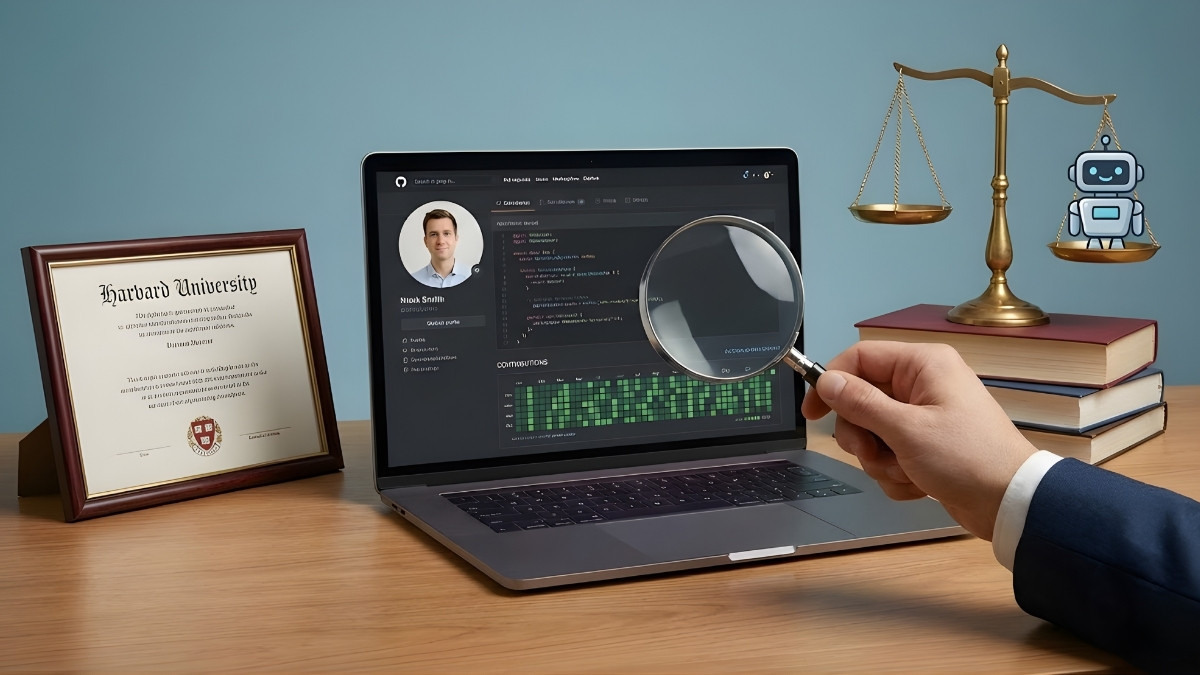
GitHub is the new Harvard — and the hiring data from 2026 makes that case better than any career counselor ever could.
A survey of more than 200 engineering leaders conducted by CodePath and shared exclusively with Fortune found that side projects and portfolios topped the list of hiring signals, cited by 38% of respondents. Public code portfolios came in at 34%. School prestige? Just 17%. A candidate’s degree or academic focus? Only 23%. The paper ceiling that kept non-degree candidates out of tech for decades is cracking — and the crack runs directly through GitHub.
This is not a story about abandoning education. It is a story about what actually moves hiring decisions in 2026 — and what most job seekers are getting completely wrong about how to position themselves for the AI job market.
The credential you need is not behind a $250,000 tuition wall. It is sitting at github.com, waiting to be built.
The Numbers That Should Change Your Job Search Strategy
For decades, the hiring funnel in tech was simple. No degree meant no interview. AI broke that shortcut in two directions simultaneously.
First, AI tools have compressed the time it takes to write production-ready code dramatically — meaning companies need fewer entry-level developers for the same volume of work. According to 2026 data from Fortune’s exclusive CodePath survey, more than one-third of engineering leaders have reduced entry-level hiring over the past year. The roles that remain are more competitive, not less.
Second — and this is what most candidates are missing — the roles that remain are being awarded to people who can show proof of work. Not potential. Not academic pedigree. Production. A GitHub portfolio with deployed projects tells a hiring manager something a transcript cannot: that this person ships.
Skills-based hiring is now the biggest trend in recruitment in 2026. The shift from “bachelor’s degree required” to “ability to demonstrate proficiency through a portfolio or competency assessment” is showing up in job descriptions across sectors.
Also Read : OpenAI vs Anthropic vs Google: Who Is Actually Winning the AI Race?
What Hiring Managers Actually Look at in 2026
The numbers from the CodePath-Fortune survey are worth sitting with. When engineering leaders were asked which signals matter most outside the interview process, the ranking went: side projects or portfolios (38%), internship experience (35%), public code portfolios (34%). Credentialing programs were cited by just 4%.
Study.com’s survey of 100 U.S. hiring managers found that 49% say education and portfolio are equally important — while only 6% think education matters more than portfolio. On-the-job training was rated the best way to build AI skills by 67% of hiring managers, followed by certifications at 61%, and university coursework at 58%.
The conclusion is not that degrees are worthless. It is that a strong GitHub portfolio has achieved parity with a degree for most applied AI roles — and for candidates who cannot access a top-tier institution, it has become the more compelling path.
AI literacy has topped LinkedIn’s list of most in-demand skills right now. A Lightcast analysis of more than 1.3 billion job postings found roles advertising at least one AI skill offered an average of $18,000 more in annual compensation. 51% of those jobs were outside the tech sector entirely.
A GitHub portfolio is the fastest way to demonstrate that skill — visibly, verifiably, and in the exact format hiring managers are already looking for.
What a GitHub Portfolio That Actually Gets Hired Looks Like
Most GitHub profiles are graveyards of tutorial projects that signal exactly the wrong thing to a recruiter. A Titanic survival prediction model. A to-do list app. A weather widget. These tell a hiring manager that the candidate can follow instructions — not that they can solve a problem.
The portfolios getting people hired in 2026 share a different structure entirely.
Build Projects That Solve Real Problems
A hiring manager skipping your resume’s buzzwords opens your GitHub to see a working GenAI-powered application. According to 2026 career research, the learning curve must match the hiring curve — faster, more applied, and deeply aligned to business outcomes.
The difference between a project that gets noticed and one that disappears is specificity. Instead of a generic chatbot, build a RAG system that parses complex legal documents — demonstrating knowledge of data pipelines, vector databases, and LLM orchestration. Instead of a basic classification model, build an ML pipeline that predicts credit card fraud using PySpark and XGBoost, deployed via FastAPI on Hugging Face Spaces.
Include architecture diagrams and performance metrics in your README. If you reduced inference latency by 20%, put that number in the headline. That ROI-focused framing is the difference between a GitHub portfolio that looks academic and one that looks professional.
Contribute to Open Source Projects
A merged pull request in a major AI library is worth more than a master’s degree from a mid-tier university. It is documentation of something a degree cannot provide: proof that your code survived peer review by engineers who had no obligation to be kind.
Contributing to projects like LangChain or Hugging Face Transformers demonstrates that you can navigate a large codebase, follow strict style guides, collaborate asynchronously, and write code that meets production standards. These are capabilities that remote-first companies specifically cannot evaluate from a transcript.
Document Everything Publicly
Writing short posts on LinkedIn or X about what you learned from a Kaggle competition, a model that behaved unexpectedly, or a deployment decision converts your technical work into visible thinking. According to 2026 career guidance from Syracuse University’s iSchool, hiring managers are specifically looking for people who are visibly thinking about the field. The candidates who get contacted are the ones who show up consistently in the conversations their future employers are already having.
Also Read : 20 AI Tools Tested: I Tried Them So You Don’t Have To
The AI Career Paths Where GitHub Carries the Most Weight
Not every AI role evaluates GitHub equally. The roles where a strong portfolio can substitute for — or significantly outperform — a traditional degree are concentrated in applied AI work.
ML Engineers and AI Developers
These roles build software systems powered by AI, integrating models, building agents, and creating production applications. They prioritize portfolio evidence above academic credentials because the work is concrete and demonstrable. A deployed application answers every question a transcript leaves open.
Prompt Engineers and AI Workflow Specialists
These roles design the inputs and systems that direct AI behavior across products and operations. Many do not require coding at all — they require demonstrated understanding of how AI systems respond to different inputs, which a GitHub portfolio of prompt engineering experiments can document directly.
Generative AI Content Creators
Study.com’s 2026 hiring manager data identifies this as one of the five fastest-growing entry-level AI roles — and it is explicitly non-technical, meaning the portfolio barrier is lower than for engineering roles. Companies need professionals who combine creative and technical skills to drive efficiency in marketing, media, and product experiences.
The Talent Shortage Nobody Is Building For
Study.com’s survey found the biggest expected talent shortages in Robotics and Automation (70%), Generative AI (67%), and AI Governance and Compliance (52%). A GitHub portfolio demonstrating AI governance work — auditing model outputs for bias, documenting responsible AI practices, building evaluation frameworks for LLM reliability — is exceptionally rare. Rare enough that a candidate with that portfolio and no degree will consistently beat a degree holder with no portfolio in a field where 52% of hiring managers cannot find enough qualified candidates.
Also Read : AI Tools Replacing Jobs: 7 Roles Already Gone in 2026
The Practical Path to a GitHub Portfolio That Opens Doors
The gap between knowing GitHub matters and actually building a portfolio that moves hiring decisions is where most candidates stall. Here is the sequence that works.
Start with AI literacy and prompt engineering. These skills travel across roles, can be learned in 15 to 25 weeks with focused practice, and produce portfolio artifacts — prompt libraries, evaluation frameworks, documented experiments — that demonstrate applied thinking without requiring an engineering background.
Build one real project before starting a second. One deployed application with clear documentation, a working demo link, and a README that explains the problem it solves is worth more than ten half-completed experiments.
Contribute to one open source project before applying to jobs. Even a small contribution gives you a concrete answer to the interview question every hiring manager eventually asks: “Tell me about a time you collaborated on a technical project with people you had never met.”
The engineers commanding $200,000 and above in starting salaries in 2026 are not the ones with the best academic credentials. They are the ones who treated their profile as a product launch — showcasing architectural decision-making, business logic, and the specific operational AI capabilities companies are trying to hire.
For most applied AI roles representing the majority of growth in the 2026 job market, GitHub is the credential that closes the gap between being qualified and being hired.
Frequently Asked Questions
1. Can a GitHub portfolio actually replace a degree for AI jobs in 2026?
For most applied AI roles, yes. CodePath-Fortune survey data shows only 23% of engineering leaders cite a degree as a top hiring signal, while 38% cite portfolios and 34% cite public code repositories specifically.
2. What types of projects should I put on my GitHub to get hired in AI?
Build projects solving specific real-world problems — RAG systems, deployed ML pipelines, AI-powered applications with documented performance metrics. Avoid generic tutorial reproductions. Hiring managers can tell the difference immediately.
3. How long does it take to build a GitHub portfolio strong enough to compete for AI roles?
With focused effort, 3 to 6 months is enough to build 1 to 2 strong deployed projects, contribute to one open source repository, and establish visible community engagement.
What is the first project you are planning to add to your GitHub? Drop it in the comments.