The Paper Ceiling: Why Skills Outweigh Degrees
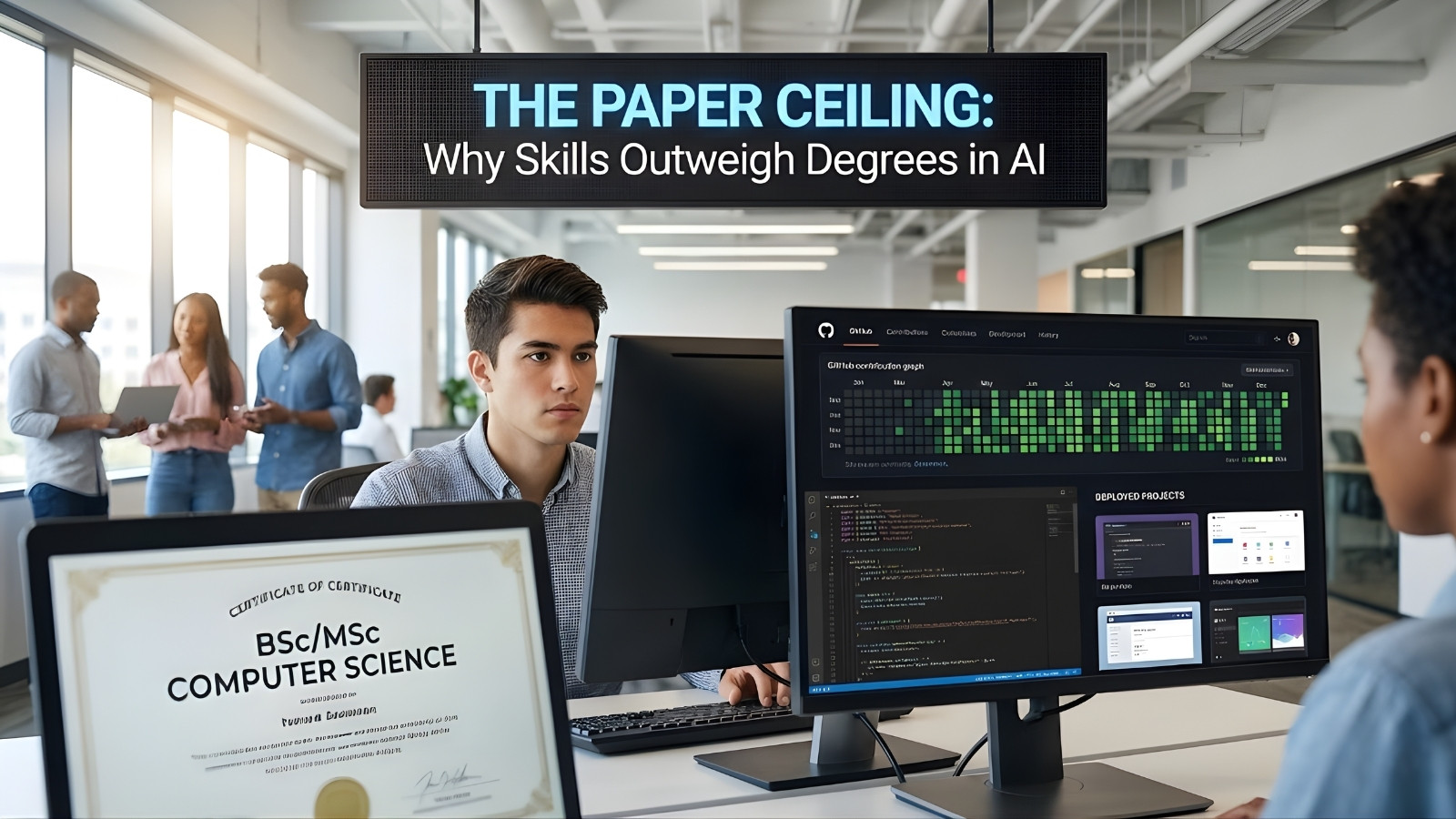
Launching an ai career in the United States today requires a fundamental shift in mindset from “academic achievement” to “market value.” For decades, a Bachelor of Science (BSc) or a Master of Science (MSc) in Computer Science was the golden ticket to a stable job in Silicon Valley. But as we navigate through 2026, the credential inflation is real. With thousands of graduates flooding the market every semester, a degree is no longer a differentiator; it is merely the price of admission. The candidates who actually secure offers at NVIDIA, Google, or high-growth startups are the ones who treat their diploma as a foundation, not the finished product.
The reality of the current US tech landscape is that employers are prioritizing “deployment capability” over theoretical knowledge. They don’t just want to know if you passed Linear Algebra; they want to know if you can optimize a model’s inference time to save them $10,000 a month in cloud costs. Building a successful ai career now demands that you bridge the gap between computer science theory and the messy, expensive reality of production engineering.AI Career
The Skill Stack: What US Companies Actually Buy
If you look at the job descriptions for entry-level roles in San Francisco or Austin, you will notice a pattern. They aren’t asking for generic coding skills. To future-proof your ai career, you need to master the tools that power the American enterprise.
-
Cloud Native AI: It is impossible to ignore the infrastructure. Proficiency in AWS SageMaker, Google Vertex AI, or Azure Machine Learning is often the tie-breaker between two candidates.
-
Data Pipelines: Models are useless without data. Knowing how to use Apache Airflow or dbt (data build tool) to manage data flows is a critical skill.
-
The Modern Stack: Familiarity with vector databases like Pinecone and orchestration frameworks like LangChain is now as essential as knowing Python was five years ago.
Also Read : AI Career Path after B.Tech: How to Land a $150k Job in Silicon Valley
The Master’s Dilemma: Debt vs. ROI
A common question for BSc graduates plotting their ai career is whether to double down on education with an MSc. In the US, where tuition can easily exceed $60,000 per year, this is a financial calculation, not just an academic one.
-
The Research Path: If you want to work at OpenAI or DeepMind as a Research Scientist, a PhD or a top-tier MSc is often non-negotiable. These roles pay astronomical salaries, but the barrier to entry is academic excellence.
-
The Engineering Path: For the vast majority of “AI Engineer” or “MLOps” roles, a Master’s degree is optional. Two years of real-world experience often yields a higher Return on Investment (ROI) than two more years in a classroom.
The Portfolio Strategy: Proof of Work
In a market skeptical of resume inflation, your GitHub profile is your strongest currency. To jumpstart your ai career, stop building generic “Titanic survival prediction” projects. Build things that solve annoying, real-world problems.
-
Fine-Tune an LLM: Take an open-source model like Llama 3 and fine-tune it on a specific dataset, like US legal codes or medical abstracts.
-
Build a Full-Stack App: Don’t just leave code in a notebook. Wrap it in a Streamlit app or a React frontend. Show that you can ship a product.
-
Contribute to Open Source: A merged Pull Request in a popular library like Hugging Face Transformers is worth more than a 4.0 GPA to a hiring manager.
The Compensation Reality
The financial upside for those who successfully navigate this transition is significant. In major US tech hubs, the starting salary for a specialized AI role significantly outpaces traditional software engineering.
-
Junior AI Engineer: $110,000 – $145,000.
-
AI Data Scientist: $120,000 – $160,000.
-
Machine Learning Engineer (Mid-Level): $170,000 – $220,000.
However, these numbers are reserved for those who can hit the ground running. The market has no patience for hand-holding. If you want to build a lasting ai career, you must embrace a culture of continuous learning. The tools you use today will be obsolete in 18 months. The only constant is your ability to adapt, solve new problems, and deliver value in a fast-moving economy. The degree gave you the theory; now go build the practice.
Also Read : Job Roles in AI: The Real Difference Between $150k and $300k